About

The Feminist Duration Reading Group (FDRG) focuses on under-represented feminist texts, movements and struggles from outside the Anglo-American canon. The group has developed a practice of reading out loud, together, one paragraph at a time, with the aim of creating a sense of connection and intimacy during meetings.

The group was established in March 2015 by Helena Reckitt, at Goldsmiths, University of London, to explore texts from the Italian feminist movement of the 1970s and 1980s. Later in 2015 it relocated to SPACE in Hackney, East London where it was hosted by Persilia Caton until April 2019. From June 2019 to February 2020 the group was in residence at the South London Gallery, where it focused on intersectional feminisms in the UK context (a planned year-long programme that was moved online due to COVID-19).

In 2023 we were one of several groups selected for the eighteen month Residents programme at Goldsmiths CCA, London.

From 2023-2024 FDRG partnered with Cell Project Space developing CEED (Central East European and Diaspora) Feminisms, funded by the British Art Network, with Cell Project Space.

FDRG sessions have been organised in London with the Advocacy Academy, Artangel, Barbican Art Gallery, Cell Project Space, Chelsea Space, Chisenhale Gallery, the Drawing Room, Feminist Library, Flat Time House, Goethe Institute, Goldsmiths CCA, Mimosa House, Mosaic Rooms, The Showroom, Sine Screen, South Kiosk, Studio Voltaire, Tate Modern, in collaboration with AntiUniversity, the Department of Feminist Conversations, and FIELDNOTES, and as part of The Table at the Swiss Church.

Elsewhere in the UK the FDRG has been hosted by Grand Union and Eastside Projects, Birmingham, esea, Manchester, De La Warr Pavilion, Bexhill-on-Sea, and Hypatia Trust, Penzance.  A sister group, NW FDRG, was set up in Liverpool by Kezia Davies in 2019.        

Internationally we have partnered with Emilia-Amalia at Art Metropole in Toronto, Canada; Kunstverein Harburger Bahnhof and HFBK Hamburg, Germany; and with ‘Hope is a Dscipline’ curators as part of the 2024 October Salon in Belgrade, Serbia. In 2025 the group contributed to Mundos Habitables (Liveable Worlds), an online resource devised by Peruvian-based curator Susan Quinilan.

Online international meetings have been held with groups including Radical Sense in Tirana, Albania, Mai Ling in Vienna, Austria, and the Gender Studies journal in Kharkiv, Ukraine.

In 2015, at the end of the FDRG’s first year, seven members - Angelica Bolletinari, Giulia Casalini, Diana Georgiou, Laura Guy, Helena Reckitt, Irene Revell, and Amy Tobin - organised the two-week long events programme, ‘Now Can Go,’ focused on legacies of Italian feminism, across the ICA, The Showroom, SPACE, and Raven Row in London.  

The group usually meets once a month, in art spaces and community venues as well as non-institutional venues such as private homes or gardens. From 2025 - 2027 we are Residents at Goldsmiths CCA, London.

The FDRG aims to create an inclusive trans-positive space. We welcome feminists of all genders and generations to explore the legacy and resonance of art, thinking and collective practice from earlier periods of feminism, in dialogue with contemporary practices and movements.

Working Group

FDRG sessions are initiated by a Working Group. Current members are Beth Bramich, Lina Džuverović, Sabrina Fuller, Taey Iohe, Mariana Lemos, Katrin Lock, Helena Reckitt, and Dot Zhihan Jia.

Former Working Group Former members are Giulia Antonioli, Angelica Bollettinari, Lily Evans-Hill, Félicie Kertudo, Ceren Özpinar, Sara Paiola, Justin Seng, Ehryn Torrell, and Fiona Townend.

Working with the FDRG: A Note for Institutions

The FDRG is run by members of the voluntary Working and Support Groups. We regularly partner with community and arts organizations to offer free events to the public.

The reading group is our collective practice that we enjoy and like sharing with others. Facilitating sessions does of course involve considerable time and effort. We also have running costs for web hosting and communication, invited speaker fees etc.

We understand financial constraints within the cultural sector, but appreciate any contributions that support our efforts.

The FDRG operates an ‘Honesty Box,’ and asks funded organisations to pay what they can.

For organisations who can access funding, we suggest a fee of £300 - £600 per session, depending on the scope of work entailed.  This roughly follows the a-n artist payment guidelines for 1-1.5 days for an artist with seven years professional experience (the FDRG was set up in 2015).

Collaborators and Partners

FDRG sessions have been led by Adomas Narkevicius, Ximena Alarcón-Díaz, Giulia Antonioli, Diana Baker Smith, Anna Barham, Fari Bradley, Beth Bramich, Giulia Casalini, Laura Castagnini, Catherine Cho, Leah Clements, Morgane Conti, Lauren Craig, Cinzia Cremona, Galit Criden, Giulia Damiani, Oana Damir, Kezia Davies, Department of Feminist Conversations, Flora Dunster, Lina Džuverović, Lily Evans-Hall, Lucia Farinati, Berit Fischer, Lynne Friedli, Sabrina Fuller, Diana Georgiou, Rose Gibbs, Marija Iva Gocic, Valeria Graziano, Laura Guy, Haley Ha, Lily Hall, Nora Heidorn, Minna Henriksson, Jacqueline Hoàng Nguyễn, Yurika Imaseki, Taey Iohe, Félicie Kertudo, Hristina Cvetlincann Knezevic, Alexandra Kokoli, Jessie Krish, Mariana Lemos, Mai Ling, Barbara Mahlknecht, Alex Martinis Roe, Jessa Mockridge, Jet Moon, Gabby Moser, Roisin O’Sullivan, Ceren Özpinar, Frances Painter Fleming, Grace Eunhye Park, Sara Paiola, Natalia Paunic, Raju Rage, Helena Reckitt, Irene Revell, Lidia Salvatori, Elif Sarican, E Scourti, Justin Seng, Sarah Shin, Zorana Simic, Something Other, Cecilia Sosa, Amy Tobin, Ehryn Torrell, Emma Yifan Wang, Ana Simona Zellenovic, and Dot Zhihan Jia.

Artists, Writers & Collectives

Sessions have been dedicated to texts and artworks including those by Clay AD, Naadje Al-Aali, Joan Anim-Addo, Floya Anthias and Nira Yuval-Davis, Gloria Anzaldua, Jenn Ashworth, Margot Badran, Sita Balani, Anna Barham, Khairani Barokka, Marquis Bey, Chiai Bonfiglioli, Anne Boyer, Brixton Black Women’s Group, adrienne maree brown, Wilmette Brown, Octavia E Butler, Sakine Cansiz, Hazel V Carby, Adriana Cavarero, Teresa Hak Kyung Cha, Anne Anlin Cheng, Catherine Cho, Barbara Christian, Lia Cigarini, Eli Clare, Leah Clements, Diane di Prima, Lauren Craig, Galit Criden, Mariarosa Dalla Costa and Selma James, Abri De Swardt, Maria Puig De La Bellacasa, Leah Clements, Claudia Durastanti, JJJJJ Ellis, Silvia Federici, Ray Filar, Leopoldina Fortunati, Leta Hong Fincher, Shulamith Firestone, Lauren Fournier, Takana Fuego, Ruth Frankenberg, Olivia Guaraldo, Katie Hare, Johanna Hedva, bell hooks, Kim Hyesoon, Onyeka Igwe, Sanja Iveković, Juliet Jacques, N K Jemison, Kathy Jetnil-Kijiner and Aka Niviana, Marie Elizabeth Johnson, Jane Jin Kaisen, Banu Kapil, Jasleen Kaur, AE Kings, Larissa Lai, Andrea Lawlor, Naja Lee Langvad, Teresa de Lauretis, Clarice Lispector, Carla Lonzi, Fereil Ben Mahoud, Alex Martinis Roe, Lea Melandri, Fatema Mernissi, Milan Women’s Bookshop Collective, Trinh T Minh-ha, Adriana Monti, Jet Moon, D Mortimer, Antonella Nappi, Astrida Neimanis, Jacqueline Hoàng Nguyen, Abdullah Ocalan, Naomi Okabe, Pauline Oliveros, Lola Olufemi, Sue O’Sullivan, Tanja Ostojić, Cecilia Palmeiro, Queer Beograd, Elizabeth Price, Darija Radaković, Raju Rage, Claudia Rankine, Tabita Rezaire, Rivolta Femminile, Lucia Egana Rojas, Sasha Roseneil, Gail Rubin, Lou Lou Sainsbury + Kari Rosenfeld, Sofia Samatar, Suzanne Santoro, E Scourti, Selma Selman, Christina Sharpe, Gayatri Chakravorty Spivak, Rhea Storr, Latif Tas, Miriam Ticktin, Tiqqun, Rosa-Johan Uddoh, Iris Uurto, Nafu Wang, Kyla Wazana Tompkins, Katri Vala, Vron Ware, Wages Due Lesbians, Wages for Housework, Francis Whorrall-Campbell, Linda Zerilli.

Contact us

If you would like to join the reading group mailing list or propose a focus for a session, or invite us to lead a meeting, please contact: feministduration@gmail.com 

Website Design by Angelica Bollettinari

Bibliographic Activism: Researching Under-Represented Cultures and Lineages

Bibliographic Activism: Researching Under-Represented Cultures and Lineages

This workshop is the third in the series Feminist Tools for Working Across Difference, the CHASE-funded PhD training programme organised across the Courtauld Institute, Birkbeck, Goldsmiths and Sussex University, in collaboration with the FDRG.

The meeting includes presentations on methods of researching and mapping under-known writing, cultural production, and networks of friendship and solidarity, with a focus on the Anglophone Caribbean. It also introduces an emerging project designed to map East and South East Asian (ESEA) Feminisms.

Contributors Alice CorbleAlison Donnell, and Dot Jia Zhihan discuss the tools they have adopted, working across radical librarianship, literary scholarship, and curatorial practice, for narrating stories and lineages that fall outside dominant histories and cultures.  Methods explored include researching short-run, self-published, and non-commercial publications; delving into overlooked archives; conducting interviews and oral histories; and developing frameworks for co-research and co-creation.  Woven throughout presentations are questions of epistemic justice and restitution, representation and redress.

The workshop will include time for participants to share their own projects and ideas for researching under-known histories and genealogies.

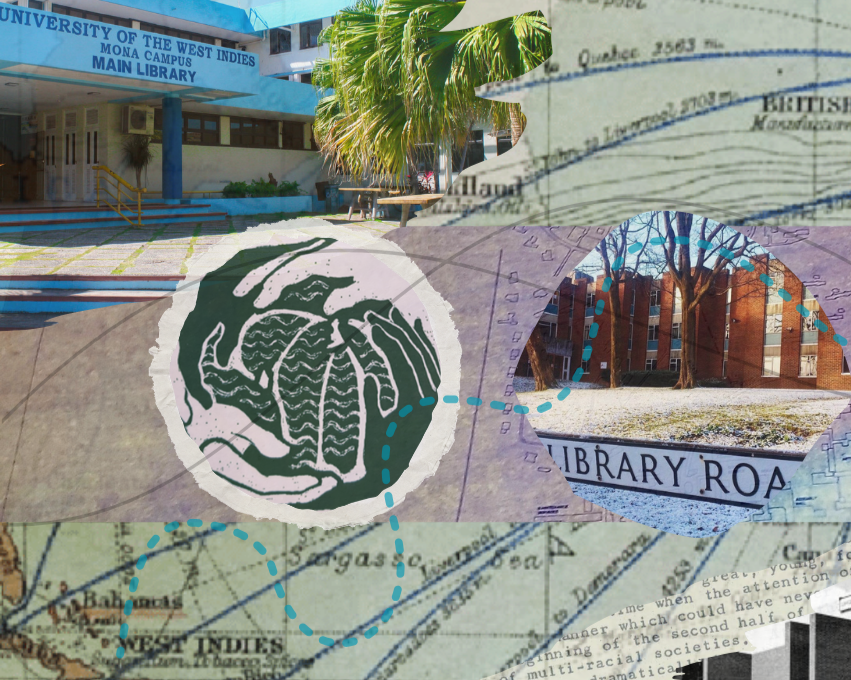
Alice Corble, Postcolonial Library Legacies and New Transnational Maps of Learning. Exploring historical partnerships, social movements and contemporary connections linking Sussex University with The University of the West Indies (via University of London), Corble discusses the central yet often overlooked role of academic libraries and archives in shaping de/colonial processes and reparative reckonings in higher education, international development, and institutional memory. She will share emerging findings and speculative approaches to mapping these knowledge formations in multi-modal co-creative ways.

Alison Donnell, Bibliographic endurance and knowledge justice. Drawing on her work researching and recovering Anglophone Caribbean women writers for her book Lost and Found: An A-Z of Neglected Writers of the Anglophone Caribbean (Papilotte Press, 2025), Donnell argues that surfacing the extent of scattered publications outside the purview of commercial and metropolitan knowledge institutions is an important act of feminist restitution and knowledge justice.

Dot Jia Zhihan, Mapping ESEA Feminisms: decentralised archiving and cultural redress. By mapping the scattered histories of British East and Southeast Asian communities through a multi-nodal framework, Dot Jia Zhihan proposes that grassroots bibliographic intervention can foster new pedagogical empowerment within UK higher education as well as communities’ histories.

BIOS

Alice Corble is a transdisciplinary scholar-activist and educator whose praxis is grounded in the social and epistemic justice dimensions of libraries and archives. She is a Lecturer in Library and Information Studies at University College London, and a Visiting Research Fellow at University of Sussex Centre for Rights, Reparations and Anti-Colonial Justice. Her Leverhulme Early Career Fellowship titled ‘Postcolonial Library Legacies and New Transnational Maps of Learning’  examines libraries as infrastructural sites of power and knowledge via connected conjunctural case studies across Caribbean–British higher education. This project builds on her previous fellowship at University of Sussex Library, which explored the library's role in Sussex's history as the UK's first "new university" founded in 1961 with an academic and geopolitical mission to draw "a new map of learning" (Asa Briggs) in the aftermath of war and empire.

Alison Donnell is head of Humanities and Professor of Modern Literatures in English at the University of Bristol. She has published widely in the field of Caribbean literature, with significant contributions to the fields of literary history and culture, recovery research of women authors, and Caribbean literary archives. Her recent works reflect her ongoing commitment to exploring and expanding literary histories, including a special double issue of Caribbean Quarterly on Caribbean Literary Archives. Her latest monograph Creolized Sexualities: Undoing Heteronormativity in the literary imagination of the Anglo-Caribbean was published by Rutgers in 2021.

Dot Zihan Jia is a curator, editor, and translator who considers diasporic feelings as worldmaking and translation as close reading. She works as Curator (Studios & Residencies) at  Studio Voltaire,, London, and teaches on BAFA (Extension) at Goldsmiths and MAFA at Chelsea College of Arts. Dot also works on the advisory board of Saloon London, organises with the Feminist Duration Reading Group and edits bilingual magazine chán. Previous projects and collaborations have been with ICA London; Spike Island, Bristol; Power Station of Art, Shanghai; Goldsmiths CCA, London; Chisenhale Gallery, London; Blindspot Gallery, Hong Kong; The Mosaic Rooms, London. From 2022 to 2024, Dot was a curator at esea contemporary, in Manchester.

BOOKING ESSENTIAL!

You can reserve a free place here.

VENUE INFORMATION & ACCESS

The workshop will take place in RHB 142 in the Richard Hoggart Building, Goldsmiths, University of London. Following introductory presentations, breakout discussion groups will take place in smaller spaces in the same building.  

Access info here. If you have any additional accessibility requirements or needs please contact feministduration@gmail.com

Image: Alice Corble, Postcolonial Library, collage (detail)
So close/So distant

So close/So distant

Pratibha Parmar: Disrupting Paradigms

Pratibha Parmar: Disrupting Paradigms